 Skip to content
The Ultimate Guide to kVA Sizing Calculation: Never Undersize Your Generator Again
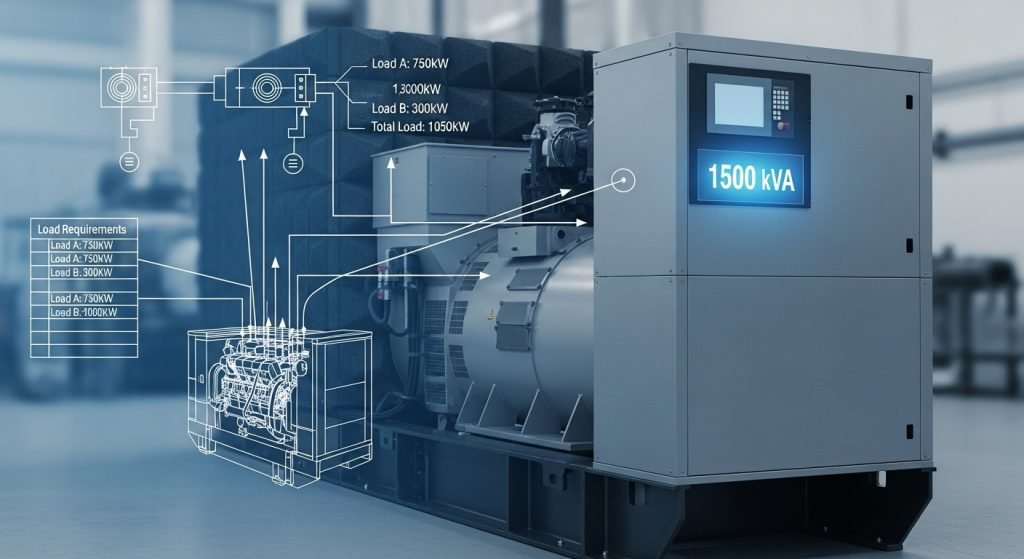
Master Generator Sizing Formula: Calculating Power Needs (kVA) for Your New Factory or Event
Introduction: The Cost of Getting kVA Sizing Wrong
You’ve got a massive project on the horizon—a state-of-the-art new factory or a high-profile, must-succeed event. Power is the backbone of your operation, and getting the generator size wrong is a costly mistake. An undersized generator will trip, fail, and potentially damage expensive equipment. An oversized generator is an unnecessary upfront expense and an ongoing fuel waste (running under light load can cause engine damage over time).
This guide is your practical roadmap to accurately determine the required kVA sizing calculation for any industrial or large temporary power application. Follow these three critical steps to ensure reliable power continuity and protect your investment.
Step 1: Inventory, Watts, and the Critical Difference: Starting Load vs Running Load
The biggest mistake non-engineers make is calculating only the running wattage. Motors, compressors, pumps, and other inductive loads require a massive surge of power—the Starting Load (or inrush current)—to initially get moving. Your generator must handle this peak surge, not just the stable Running Load.
This guide is your practical roadmap to accurately determine the required kVA sizing calculation for any industrial or large temporary power application. Follow these three critical steps to ensure reliable power continuity and protect your investment.
Building Your Load List
- List Every Item: Create a comprehensive list of every single device, machine, light, and appliance that will be connected to the generator.
- Find the Power Rating (kW/Amps): For each item, find its rating on the nameplate or in the manual. Record both the Running Wattage (kW) and the Starting Wattage (kW).
・If the rating is in Amps (A): You will need to convert this to Watts/kVA later.
・If the Starting Wattage isn’t listed: Use a multiplier. A general rule of thumb for standard motors (like an air conditioner or conveyor belt) is 2x to 3x the Running Wattage for the surge. High-inertia loads may be even higher.
- Identify Load Groups: Separate your loads into two groups:
・Priority 1 (Must-Run Loads): Equipment that must start instantly (e.g., lights, life safety, IT servers).
・Priority 2 (Staggered Loads): Equipment that can be started sequentially (e.g., heavy machinery, large compressors). This is crucial for managing the total starting current.
Factory Power Requirements Example:
| Load Item | Running kW | Starting kW (Est. 3x) | Priority |
| :— | :— | :— | :— |
| CNC Machine 1 | 15 kW | 45 kW | P2 (Staggered) |
| Server Room UPS | 5 kW | 5 kW | P1 (Instant) |
| Office Lighting | 3 kW | 3 kW | P1 (Instant) |
| Total Running Load | 23 kW | – | – |
Step 2: Summing the Load: Calculating the Worst-Case Peak
Your required power size is determined by the highest power draw at any single moment. This is almost always the instantaneous spike created by starting the largest motor while everything else is already running.
Calculation:
Total Peak kW=(Total Running kW of all other equipment)+(Starting kW of the single largest motor)
Using the example above (and assuming the CNC machine is the largest motor):
Total Peak kW=(23 kW−15 kW)+45 kW=8 kW+45 kW=53 kW
This 53 kW is the absolute minimum amount of real power (kW) your generator must produce instantly.
Step 3: From kW to kVA: Applying the Generator Sizing Formula
Generators are rated in kVA (kilovolt-amperes, or Apparent Power), not kW (kilowatts, or Real Power). The relationship between the two is the Power Factor (PF).
he standard industry Power Factor for most large generators is 0.8.

H3: The Final Margin: Safety and Future-Proofing

Action: You would need to round up to the next commercially available standard size, which is likely a 100 kVA Generator.
Conclusion: Get a Professional Audit to Guarantee Success
While this step-by-step guide is the foundation of accurate sizing, real-world factors like altitude, ambient temperature, and complex motor-starting methodologies (Soft Start, VSDs) can impact your final decision. Don’t let a simple calculation error jeopardize your project.
🎯 TAKE ACTION NOW: Book Your Free Generator Sizing Consultation.
Our certified engineers will take your detailed load list and perform a professional power audit, ensuring you get the exact right size—nothing more, nothing less. Stop guessing your factory power requirements and start powering your success!
